From Kindergarten through Eighth Grade I attended a private Christian school in a small town near where I live. We mostly used a self-taught curriculum and classes were separated by groups of grades since our school was so small. These groups occasionally fluctuated from year to year. The summer after Eighth Grade, before my Freshman year, my parents pulled us out of enrollment there. I was away at Bible Camp and they forgot to tell me until I asked sometime late July or early August when we were going to get our uniforms. I digress. My Freshman year I was homeschooled using this same curriculum. I can only assume it was thought that since this was self-taught, the transition to homeschooling would be smooth and easy and we would be able to accomplish our work without much effort on the part of adults. What actually happened is I didn’t do any subject I wasn’t interested in or couldn’t understand. I remember realizing that if I kept up with this, I would basically never have more than an Eighth Grade education, though I would have a High School diploma—mom was filling out the transcript anyway and submitting it, no problem. My friends had gone to public school and I made a list of reasons (I don’t think it was quite an actual PowerPoint, but definitely same concept) about why they should let me go to public school. This might seem like a simple agreement for some, but having come from a private Christian school where I was intentionally enrolled and a negative stigma against public schools rampant from the opinions of the mouths of many of the adults that surrounded me (never mind that half our church had kids in public school) it definitely took some persuading. I’m not sure how I got the courage to do this, I don’t remember, and I don’t know how I got my parents to agree, but they did, especially considering I couldn’t drive quite yet and we lived out in the country and my mom wasn’t a big fan of taking me places.
Sophomore year is when they bring the students in one at a time to meet with the Counselor to see what you might see yourself studying after graduation in either a college, university, or trade school. I remember sitting in that office riddled with anxiety, having no clue what my life would look like this year or how to navigate it, let alone what it would look like once I was graduated. She asked me, “well, what are you good at?” and the panic only increased; I’m not good at anything. I’ve had an unconventional schooling experience by comparison up until this point, and the limited options we had through Eighth Grade were things I definitely wasn’t good at. I thought about the fact that I volunteered at my church and I seemed to be good at that, so I said, “I don’t know, helping people?” and she said, “what about being a teacher? or a therapist?” to which I wasn’t sure. The latter especially was a hard no to me as I had the thought, “if I can’t even handle my own issues, how could I help anyone else through theirs?”
My Junior year, as I looked over the options of classes I noticed American Sign Language was available as a foreign language to Juniors and Seniors. Having learned a few songs in ASL at my private school and remembering I was good at it and how much I enjoyed it, I asked if I could take that instead of Spanish. Finally, something I was good at. I took ASL 1-4 in the two years, was voted “Who’s Who of American Sign Language” (which, there was four of us Senior year), and really took to this language and culture in a way that’s hard to explain. My teacher encouraged me to look into going to school at our local community college for an ASL Interpreting degree.
When I graduated, I went to the Bible College attached to the Bible Camp I’d gone to almost every summer since I was 4-years-old, a dream of mine since I can remember. I wanted to go to the college, work at the camp, and be full time staff, living out the rest of my days working for this place that was such a big part of my life and one of the only safe and consistent places for me. This was a two year, non accredited school. I was top 10 my first year, Salutatorian my second year, and against all odds was on summer staff both summers. (The first made possible by a friend of mine on staff who requested me for his department after the first pick turned it down. He got struck by lightening before summer began and I ended up running the department myself with only the knowledge of what I had from interning at the summer camps. 18 hour days, and I was the only staff member to not get sick that entire summer. Also, he survived, but with immense mental deficits as the lightening entered the right side of his head and out his left foot. Wild times.) After my second summer, I applied to be full time staff but was rejected. At the time, this was the biggest loss I could imagine. Everything I’d ever hoped or planned for was now impossible and I was faced with going back home to a place I didn’t enjoy with no back up plan, feeling like a complete failure, especially when compared to my contemporaries.
I got a job and looked into what it would take to go to the local community college for that ASL Interpreting degree. As a rather anxious human pre diagnosis, this was quite the feat for me to make the calls and meet with the adults that could answer my questions, let alone actually asking those questions. Still, I did it, and they seemed very happy to have me, but then financial aid fell through due to issues with my parents information (long story) and I couldn’t afford to go. I later learned my sister and I both had college funds, but she got them both since no one thought I’d go to “real college” when I got home and we were in the middle of the Great Recession.
For ten years beginning in 2008, I flitted around from job to job, taking what I could get until something better came along. I wasn’t anywhere longer than about 6 months for the largest chunk of that, my longest stint being 2.5 years before I had to quit because by that point my health had tanked so badly I couldn’t tolerate an 8-5 without passing out. By this time, I had been taking ballet classes for a few years and was teaching the younger dancer classes and as I had to strip down my life to the bones and rebuild it back up in hopes my health wouldn’t get increasingly worse or remain that way, I was able to keep the dance classes—even though teaching looked like my sitting on a stool verbally giving instructions to the class and my assistants I requested basically doing all the actual teaching. I’m eternally grateful.
In this time, I’m pricing wheelchairs but hesitating before ordering one, partially because I couldn’t afford them and also partially because I was told by one doctor if I started using one I’d likely never get out of it. My muscles would atrophy and bones become weaker and it would lend to a complicated life shift. This also coincided to what I call the “Great Revolution” of sorts in my personal life where I realized everything I’d been doing was not working and if I kept going this way I’d end up on the debilitating end of my conditions and basically be a ward of my sister my entire life. This could not happen. So I began by challenging every thought that entered my head with two questions: “Why do I think this?” and “Who told me to?” Over the years I was able to pinpoint what was actually something I believed or believed in, what was serving me, what was harming me, and I began to re-pour my life’s foundation and slowly be able to build my life back. I went from being unable to walk a grocery store without passing out to holding a (albeit extremely simple and low stress) part time job at the courthouse in the same department as my sister with a boss who was the opposite of the bosses I’d had before. Here, I was able to further unlearn some of the conditioning I’d acquired and show myself that people in authority can be safe and what I’d experienced before wasn’t how it is everywhere. This did end up being too much to allow me to continue also teaching the ballet classes I loved so much and in March 2020 I told my ballet bosses that this would be my last year teaching. And then we broke for Spring Break and the world shut down, causing that season to end there.
Flash Forward to today as this back story is long and I haven’t even begun to write about the actual point of this post: I work in local government in that same part time job I got at the end of 2018. I’ve worked here knowing that if you’re full time, they offer a tuition reimbursement program to employees who pursue degrees. I’d assumed the whole time that this was just another thing I’d never be able to take advantage of because I’d screwed myself over with all my health conditions (triggered by stress) and wouldn’t be able to handle a full time job and school.
Lo and behold on January 6 in the year of our Lord 2025, something clicked, and I realized I could actually handle taking on classes. The irony is that I’m actually working two full time jobs as the performance studio arm of the teaching studio I worked for hired me on a few years back to work for them as well. My health has slowly been improving over all this time, with baby steps here and there in the right direction, the most recent breakthrough being realizing I can eat walnuts which helps reduce the inflammation in my brain stem that’s causing most of my issues, but all of those details are for another post.
Again, I did the terrifying thing, I asked the questions, I somehow figured out how to apply for school, register, found the locations of all the classes, etc which may not seem like a big deal for most but for me is substantial. I have four classes this summer, two in each Summer I and Summer II, with my first in person class being General Psychology—the real point of this blog post. (If you’ve made it through all this pre-info, bless you.)
I’m pretty sure I was so nervous I was shaking that first day of classes. The teacher I’d chosen was one recommended by a dance mom friend who used to work at the college and said she was outstanding, so I felt a little bit of hope that if all else failed, I’d at least have a good teacher. I did as much preparing as I could to allow myself to at least feign confidence until I was familiar enough with the campus and the practices and everything that goes along with getting a college education. The first day, I couldn’t find the elevator and forgot to scour the maps for it before. I took the stairs, which is one of the limitations I haven’t been able to shake myself of (along with reading physical books), and the rest of the day my brain was a bit of dead weight, thought being too difficult to hold on to for long enough to be substantial. I took rigorous notes as I knew that the most important information for how to be successful in this class would be given that day and I knew my brain wasn’t to be relied upon to hold onto it that day.
The last time I’d been in a conventional learning environment was almost 20 years ago, when notes were taken with paper and pencil, tests were taken on scantrons (which felt so futuristic), and research was done exclusively in libraries. Most students didn’t have cell phones and those who did likely couldn’t access a web browser from them. I’ve heard certain terms from teacher friends that I knew to be related to how school is done now, but I had no personal experience with it. Using the platform Canvas was entirely new to me and I was concerned I’d be expected to be proficient on the ins and outs of it from the start. I was also in a class with students who attend one of the Collegiate schools, making them mostly Juniors and Seniors in high school, some of them having mothers who graduated while I was in high school.
These “kids” took me right in as a peer, and my teacher, Dr. A, assumed nothing going in to this semester. She was very clear on expectations, walked us through how to access our textbook through Canvas and the further connection of McGraw-Hill, walked us through how to do the Chapter Mastery requirements for the class, and even showed us how to access Tech Support, emphasizing how wonderful they are to work with. I cannot express the relief I felt this first day, fuzzy brained and all.
The class was spread out over 6 weeks. Given that usually a semester is 16 weeks, we were squeezing in quite a bit of information into our time, having a Chapter Mastery due about every other day or so, an exam every other week, and occasional work on the weekends due to holidays throwing off our groove. I found a way to read through the text book without passing out, taking cues from the fact I can quilt (which is more paced) but not crochet (which can be powered through) and taking notes as I read to help break up whatever it is that causes my brain to shut down after a few pages.
Two days before our first exam Dr. A presented us with a survey the department passes out to all of the classes with various questions. She said it wouldn’t count against us, but any of the questions we got right would be extra credit. I felt zero hope on this and told myself I’d be proud if I get just one answer right and just sort of did my best with it. We got our results back the day before our exam and I was confused at first. Did she say this was just a completion grade? But then the girl who sits next to me, Lilly, told me she got seven correct, and I realized that the “5” on each side of my page was telling me how many I got correct on each side and somehow I’d managed to get them all right. I was shocked, and instantly felt that this is where I’ve peaked—this is going to be an omen of sorts because if I did so well on this that means I’m going to bomb my first exam, right?
Apparently my assumptions are misguided. I managed to score an 88 on the exam, but with the curve it was a 93. I was pretty surprised and felt that surely this was the peak, but also was shocked because I didn’t try all that hard. Wasn’t I bad at tests? Wasn’t I not that great of a student?
I got excited during these next few classes because we learned about the importance of sleep, which Dr. A stressed to us, explaining how it’s better to study over a series of days and get good sleep at night so our brain can process through everything we’ve taken in rather than a couple days of all night cramming. She also talked about the effect stress can have on the body and these two topics are huge contenders in what I learned led to the bulk of my health issues I’ve been trying to combat largely on my own. Stress was a huge trigger for the worst of it, and I must prioritize rest or else I’m not nearly as effective as I can be. It’s not often this comes up organically. I was thrilled.
The second exam covered four chapters that were pretty intense, full of information over a wide array of complex topics with little time to grasp them. I felt Dr. A did a great job of explaining them to us in lecture and had practice modules on Canvas available for us as well and I was feeling fairly confident in them in the lead up to the exam. The day before, she gave us a handout to help us apply three of the more complex concepts. We got through the first page and I felt I had a decent grasp on it. We got to the second page, and we get into our small groups to go over what we thought the answers were to a series of worded questions about the next topic. I felt pretty good about it until we went over it all and on the fifth question it was nothing close to what I thought it was.
This sent me straight back to fourth-grade-me, trying to learn fractions and not understanding how they were getting the answer. Back then my teacher was out and I was too afraid to ask the High School math teacher for help and I developed a complex with math I still haven’t found my way through. This time, I held in the panic I was feeling and stayed after class to ask Dr. A how she got that from this question, completely blanking about the third page entirely as I was trying my hardest not to go into full blown panic. Dr. A told me, “this is a poorly worded question and I won’t word them like that on your test” and I asked “so is the answer A or C?” and she replied, “It depends.” At this point, tears are just falling out of my eyes. I felt like an idiot and said, “this feels like a word problem in math class and I’m really bad at math.” She said, “I teach statistics and help people with their math trauma all the time, it’s okay” then she asked if I had a moment and we sat down at one of the desks. She told me there’s 50 questions on the test and it covers four chapters, then asked me how many questions that gives me for each section. I said, “When I say I’m bad at math, I mean it. I missed a bunch of questions in ASL not because I didn’t know the number signs but because they wanted me to give an answer to a simple multiplication problem and I couldn’t manage it.” She said, “It’s a little over 12” to which I replied, “I believe you.” Then she went on to explain how even if I completely bombed this section, which she didn’t think I would, that I would be okay. I was thinking how I didn’t feel confident in any of the sections and my brain wanted to spiral about how I could bomb all of them, but I shut it down. She didn’t need to see that side of me, especially when she was helping me.
I’m going to paraphrase the next bit because I was coming down from the panic, trying to keep the spiral side of me silent, and also taken aback by her next words that I don’t remember exactly what she said, but it was something to this effect; “Emilee, you’re one of my brightest students. You really should consider a degree in psychology”.
Wut.
I left shortly there after, having calmed down but crying a little bit in my car. Letting myself feel is still something new and I’m learning how to allow myself to do it, especially at this point, so I gave myself the drive to process through it until I had the time to go more in depth later. The last couple days had also been filled with many of those little annoyances that are enough to derail an already tense day, and as I tried to reassure myself that I would have time to go over the information that evening and do the practice modules that would likely help clarify things, more things kept derailing including someone stopping by the studio and taking up 45 minutes of my time I didn’t have to spare with a question that could have been a one sentence text, and then being unable to access the module. The panic came right back up. In the end, I told myself that if I didn’t have those available to me, I could still read the concept in my book and try to work through it with the information I did have. I was going to be okay. I gave myself until 7:30, then I had to go home, make myself eat, and calm down enough to sleep well, the latter two of these three tasks being things I struggle with on a good day.
The next day, I joined in with the study group that formed from the “kids” that sit near me in class. We went over the details of the ear and eye, each ending up being the extra credit on either of the two versions of the test. I was grateful for their help as that’s what got me the extra credit points I managed to scrape up. I took the exam, feeling more confident than I expected. The way I described it was if I was wrong, I was confidently wrong. When I turned in my exam, Dr. A asked me how I was feeling, and I told her I was feeling alright. I thought that was very kind of her to check in. I wasn’t expecting it, being used to largely having to handle things myself, consideration like that being something I don’t come by often. It meant a lot. We got these exam results quicker, and the next day I found that I received a 94, no curve, with all but one of my incorrect answers being in the first section—about the eye. Of course I didn’t go over that section, focusing on the more complex ones and assuming I knew enough to get by. I couldn’t help but laugh.
The chapters we covered before the third exam were absolutely packed with information; different specific psychologists and their different specific methods on different specific things, the different psychological conditions that were covered, different types of therapy, different stages of development—so much information. We were all feeling a bit of the pressure, the study group meeting again and often, though I was only able to join for about half an hour on the day of the exam. This time, it all felt more “clinical” for lack of a better term. Not so much needing to know exact definition, but definitely needing to remember which psychologist had which theory and what happened with each experiment, etc. Again, I felt if I was wrong I was confidently wrong, so I just took it for what it was, took my time, and did my best. She had them graded by that afternoon (Wonder Woman, I swear) and the group chat blew up again. I’d gotten a 95, no curve, no extra credit. A 95 all on my own with an entirely multiple choice test. At this point, I’m thinking back on my history with schooling. I knew I was a smart kid in elementary school, but about 6th grade all of that went out the window. I got my first B, cried in the back of my friends mom’s suburban, failed my first test the next year, more the following, then by the time I’m in public school I’m just doing what I can to stay afloat. What I’m starting to see in this class is that, over all that time, I was doing my best to survive to where school was so far secondary I couldn’t do any better than I was. The changes that greatly affected me began in 6th grade, and got progressively more intense for years way past my school days. My church closed, my family moved out to the country and away from proximity to anyone, they pulled me out of school, my best friend moved to another state before technology had us connected like today, my great grandma died, my grandpa died, my other grandpa died, my friend died, then another friend, and another, and another x30 before I stopped counting after five years, the abuse began, then more change, then more and other abuse, more friends dying, my own near death experiences and health challenges, then my health fully tanked…all these things just stacking one on top of the other with all the other nuances of life mixed in amongst the rest of it. Did I mention the hurricane that wiped out a nearby town, trashing my parent’s house with it? It’s no wonder my grades began to slip, that I struggled to take tests or learn new things, that I wasn’t all that good at writing essays.
My goal going into this at the beginning was maybe a B or better, but once I got an A on that first exam, I thought, “maybe I can manage an A.” Then when I got a 94 on the second exam (which ended up actually becoming a 96) I thought, “maybe I can manage a ‘Highland A'”. At my private Christian school, the grading rubric was different. An ‘A’ was a 94-100, ‘B’ was a 88-93, ‘C’ was an 80-87, and anything below an 80 was failing. To end this class with a 94 or above felt far fetched, but would feel almost full circle; back to that little girl I was in elementary who was confident, smart, safe. But could I manage that? 16 weeks worth of a college class in 6 weeks?
You see, this class isn’t the only thing happening at this time. Of course it’s not. Life be life-in’ and it doesn’t stop for anyone. During this, I’m still working two jobs, dog sitting between three different families, I finished two quilts, and then there’s the general life happenings and my health sometimes likes to remind me that it’s still not the happiest with me. I’ve had the immense privilege to be in therapy for the last year and a half with an absolutely incredible psychologist. There have been some pretty intense sessions we’ve had lately and one of the defining themes was hitting a sort of point of finality. I couldn’t see a way around or past it, but I knew there had to be something I was missing. It was quite overwhelming at times and extremely emotionally taxing, at one point causing me to ask my therapist point blank, “is this even something that’s supposed to happen?” and she replied with, “well, it depends. It depends on what you want.”
You mean, I get a choice?
Of course I know I have a choice in my life, but this really struck me. This concept was about my place in the world, if I’m even anyone’s priority (I’m not), and how the hell is someone supposed to handle being no one’s priority on the days when life feels like way too much and I’m overwhelmed? Who am I supposed to turn to? I have my friends for when it gets to that extreme that if you understand I’m so sorry that’s something you have to understand, and I’m grateful for those friends that answer me in my darkest, but what about these in between times? The moments when I know things will be okay, that it won’t always be like this, that there’s nothing anyone can actually do about it, yet I’m in this heightened state of rage and everything feels like too much? Is this—letting someone be there for me in these moments—even supposed to happen? Am I supposed to put this burden onto my people who are already burdened with so much else from their people (family, kids, etc) when I know that this will pass and I’ll be fine by the morning? My therapist tells me it depends on what I want.
And that’s when it all clicks.
In my general psychology class, I’m learning the overview of psychology, touching on many different topics within the field, getting the science behind what I’m learning. In this, I’m reflecting back on my own experiences as they become relevant, evaluating what I know with what I’m learning, applying that thinking pattern I adopted almost 8 years ago: “Why do I think this? Who told me to?”
In class, I get a kick out of dropping tidbits of my life seemingly out of nowhere to see my table mate’s reactions. You don’t really expect it out of me, which is half the fun, and being this is a psychology class it was often relevant. More than once, the girl next to me would say, “girl, are you okay?” which would make us both laugh and I’d say some sort of quip like, “my therapist earns her keep!” which would then open up the floor for exciting questions from someone their age such as, “do you find therapy to be worth it?” and I can tell them that, with the right therapist, it’s more than worth it. You may not find the perfect fit first try, and that’s okay, but keep trying because finding the right therapist is like magic and it’s such a huge privilege to even have the opportunity to attempt to see one. What I didn’t expect was for their reactions to show me how abnormal my experiences have been. To me, it’s all I’ve known, and I’ve been told, “it’s not that big of a deal” or “quit being dramatic” so much that it’s so ingrained I couldn’t even reach the thought to be able to hold it up to my two questions of clarity. But now it’s excavated from the depths of my being, held into the beam of my headlamp, fully exposed. Why do I think that these extreme experiences I’ve had are normal, casual, not that big of a deal? Who told me to?
They aren’t. They are big deals. They are traumas that I have faced and thankfully survived. The things I have been through in response to them aren’t moral failings but rather symptoms of my body, mind, spirit reacting to them, trying to keep me going in spite of it all. Sure, people “have it worse”, but this has been bad, too. It’s a lot, and I don’t have to downplay it. It’s up to me if I’m going to “play the victim” to it, and I think it’s pretty clear with the work I’ve done over the last almost 8 years, and the progress made in therapy over the last year and a half that I don’t want to play the victim. I want to learn, I want to understand, I want to grieve and begin to heal.
I’ve made great progress with that in recent days, but there’s something about the wonderful trifecta of an established, supportive, safe therapy practice, a psychology class taught by an incredible human where I’m learning the science behind psychology that I can apply to my experiences, and the support of these high schoolers with their wide eyes to the world, under developed prefrontal cortexes, and welcoming presence that has brought me to this place of clarity.
When it clicked, the “it” is the fact that for so much of my life I have been told, be it through word or action, that I can’t trust myself. That I am not a safe place for myself. I’ve been told to question my intuition, to not question authority even when they go against my experiences of what I know to be true, that coping mechanisms I turned to to keep myself from the extremes of mental distress meant I was “possessed by a demon” or not safe to be alone or if I disclosed it then people wouldn’t trust me with themselves or their kids or they’d look at me with those eyes full of pity and fake concern (If it doesn’t concern my therapist, then it shouldn’t concern you either), to just deal with all the ways my body was telling me something isn’t right and when doctors told me it wasn’t anything, welp, that’s all there is. For 36.5 years of my life I have been made to believe that I can’t trust myself, that I am not a safe place for myself. That I had to find my affirmation through other people telling me I was safe, confirming that my choices were okay, and to know that I wasn’t alone.
But I’m not alone. I never am, except that all of us sort of always are. As Glennon Doyle said it, I’m the only person who will be with me my entire life. (Or did Amanda Doyle say that? Regardless, check out their We Can Do Hard Things podcast. So good.) When it comes down to it, I’m all I have, and as long as I make myself my priority, I don’t actually need anything else. This doesn’t make me a lone wolf like I was made to believe it did. This isn’t me being a recluse or antisocial in a society that is very much one in which you need other people to survive. I still need my people. I still need to text my friend the drama of the day, or see another friend when our schedules allow, or face time my niece to hear about her summer intensive. I still need to show up when my friends, who have their people who are their priorities, need me, and I know they’ll show up when I need them in spite of it all. But when it comes down to it, I am my own priority, and that is all that matters. I am all I need.
I truly thought the possibility of me being able to get an ASL Interpreting degree had passed. That it just wasn’t in the cards and life had dealt me too difficult of a hand to make it happen. But what is meant for you will find you, and now I have hope, true hope, for the first time in a long time. I have a five year plan for the first time ever and even in such, I know it leaves room for fluctuation or new opportunities. I’m “pregaming freedom”, as I told my therapist on Monday, and it’s a euphoric way of going through life that I didn’t know was actually possible.
This is why we do the work. This is why we push through. This is why we try. It’s hard as hell and exhausting as fuck, but if you can open your mind to the possibility that life might not be what you’ve been told it’s been your whole life and that better is out there and begin to take steps in the direction of where that little candle of hope inside is telling you to go, it’ll open up to you.
All in good time, it’ll find you.
I used to think, if I had a top 5 of favorite memories of my life, what would they be? And I would struggle to come up with them. Not because I haven’t had good moments in my life, but it felt like somethings was missing or not quite right or laced with difficulty in one way or another. It’s hard to explain. But now, this week, I have a certain, without a doubt favorite memory of my entire life thanks to my psychology class. The combination of getting (almost) the entire class to sign a certain book for Dr. A, not giving into the anxiety trying to tell me not to go through with giving it to her because what if it’s not ethical or it gets her in trouble or she doesn’t find the humor in it that I do? The sound of her exploding in laughter, tears in her eyes from the pure joy of it all, and her reading it to the class the next day before our last exam, everyone around me enjoying it just as much, knowing how much this class has meant to them and how much they all also appreciate Dr. A.
This class has been six weeks of magic in a way I never could have anticipated. I am a better person today, July 3, than I was on May 27th when I first stepped foot into that class (after Dr. A found a group of us down the hall because we had somehow been given the wrong room number). I hold this experience in my heart and know I will be reflecting back on it as a touchstone the rest of my life.
People say this kind of shit, that some experience meant a lot to them and they’ll never forget it, and most of the time they’re just saying the words that they feel are supposed to be said when something signifiant ends, but in my case I mean them.
And in case you’re wondering if I managed that “Highland A” for my final grade?
I got a 101.9%.
Hell. Yes.
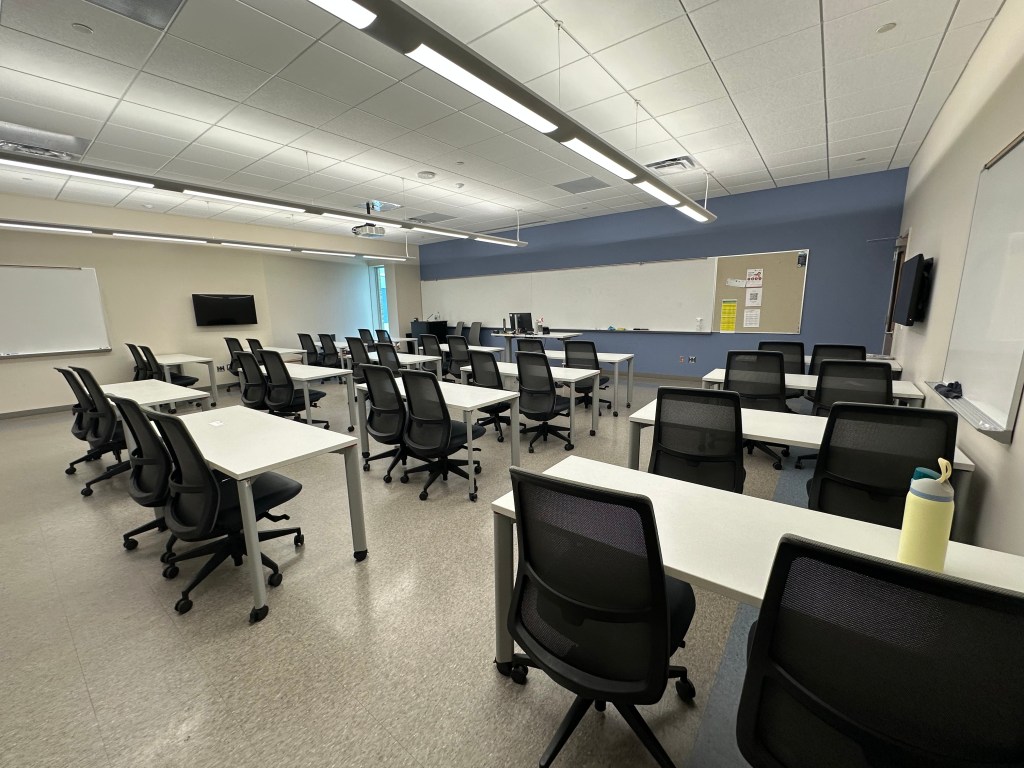
(photo of an empty college classroom with four rows of tables each with two rolling chairs at them. Three rows have four tables, the fourth row has three. A blank whiteboard is at the front of the class.)
 1988-
1988- 